The legal world is currently standing at a crossroads that many experts compare to the invention of the printing press. For centuries, a contract was a piece of paper—a static document that relied on human trust, expensive lawyers, and slow-moving courts to function. If one person didn’t pay, the other had to sue. But as we move through 2026, the rise of “Smart Contracts 2.0” is changing that narrative. These are not just lines of code; they are self-executing agreements where the terms are written directly into a blockchain, making them immutable and automatic. The question remains: is code really a sufficient replacement for the nuance of traditional law?
Understanding the technical layer of these digital agreements is becoming a core requirement for anyone entering the legal or business fields today. Because the logic behind Solidity and decentralized protocols is so dense, many students are turning to professional Assignment Help from specialized teams like myassignmenthelp to bridge the gap between computer science and legal theory. This shift is crucial because a smart contract doesn’t understand “intent” or “fairness”—it only understands if/then statements. If the code says the money moves on Tuesday, the money moves, regardless of whether a real-world emergency occurred.
1. The Evolution of Blockchain 3.0 and Self-Executing Logic
The first generation of smart contracts was relatively simple, mostly handling basic token transfers. However, “Smart Contracts 2.0” utilizes Blockchain 3.0 technology, which allows for much more complex interactions. These protocols can now pull in real-world data through “Oracles”—external data feeds that tell the contract if a flight was delayed or if a weather event occurred. This allows for “Parametric Insurance,” where a farmer gets paid automatically if a sensor detects a drought, without ever having to file a claim.
Despite this efficiency, the “Code is Law” philosophy has hit several major roadblocks. In traditional contract law, if a contract is signed under duress or contains a mistake, a judge can void it. A smart contract, by design, is nearly impossible to stop once it has been deployed on the blockchain. This rigidity is the primary reason why legal experts argue that code can complement, but not yet replace, the human element of the legal system.
2. The “Grey Areas”: Why Nuance Still Matters
Traditional law is famous for its use of “fuzzy” language. Terms like “reasonable efforts,” “good faith,” and “best interests” are used because the world is unpredictable. A human judge can look at a situation and decide if a party acted fairly. A computer program, however, requires absolute binary certainty. It cannot interpret what is “reasonable” unless a developer defines it in exact numbers.
This conflict creates a significant learning curve for those studying the future of the legal profession. Navigating the intersection of “Algorithmic Dispute Resolution” and statutory law is why many are seeking Law Assignment Help to ensure they accurately grasp how these hybrid models function in a global economy. As we move toward a more digital society, the ability to translate legal intent into programmable logic will be the most valuable skill in the marketplace.
3. Comparing Systems: Traditional vs. Smart Contracts
To understand the magnitude of this shift, we must look at how these systems handle the fundamental pillars of an agreement.
| Feature | Traditional Contract Law | Smart Contracts 2.0 |
| Execution | Manual / Court Enforced | Automatic / Code Enforced |
| Language | Natural Language (English/Latin) | Programming Code (Solidity/Rust) |
| Modification | Possible via Amendment | Difficult (requires new contract) |
| Dispute Resolution | Litigation or Arbitration | Algorithmic / DAO Voting |
| Cost | High (Legal Fees) | Low (Gas Fees/Transaction Costs) |
| Speed | Slow (Days/Months) | Instantaneous |
4. Hybrid Contracts: The Best of Both Worlds?
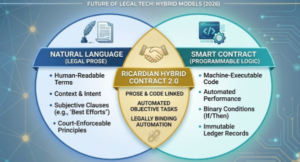
The most likely future is not the death of traditional law, but the birth of the “Ricardian Contract.” This is a hybrid model that is both a legally binding document (readable by humans) and a smart contract (executable by machines).
- The Human Layer: Contains the “Force Majeure” clauses and the intent of the parties.
- The Code Layer: Handles the repetitive, objective tasks like monthly payments or interest rate adjustments.
- The Oracle Layer: Provides the “truth” from the outside world to trigger the code.
5. Enforceability and the Global Regulatory Maze
One of the biggest hurdles for Smart Contracts 2.0 is the lack of a unified global regulatory framework. If a smart contract is executed in a decentralized way across nodes in five different countries, which country’s laws apply when something goes wrong? In 2026, we are seeing the first “Decentralized Autonomous Organizations” (DAOs) being recognized as legal entities in certain jurisdictions, but the rest of the world is still catching up.
Students and legal researchers must now look at “Jurisdictional Agnosticism.” This means creating contracts that are valid regardless of where the parties are located physically. This is a massive shift from 19th-century legal principles that were based entirely on borders and physical signatures.
6. The “Oracle Problem” and Data Integrity
A smart contract is only as good as the data it receives. If a contract is programmed to pay out based on a stock price, and that stock price feed is hacked or manipulated, the contract will execute the wrong payment. This is known as the “Oracle Problem.” To solve this, 2026 technology uses “Decentralized Oracles” that take an average from dozens of different sources to ensure the data is accurate.
7. Security Audits: The New “Legal Review”
In the past, you would have a senior partner at a law firm review a contract for loopholes. Today, you have a software engineer perform a “Security Audit” on the code. A single bug in a smart contract can lead to millions of dollars being drained in seconds. This has created a new career path: the “Legal Engineer.” These professionals are trained in both law and software development, ensuring that the code accurately reflects the legal agreement without introducing technical vulnerabilities.
8. Common Use Cases for Students to Study
- Supply Chain Management: Automatic payments triggered by GPS data when a shipment arrives.
- Intellectual Property: Instant royalty distribution for music streaming or AI-generated art.
- Real Estate: Tokenized property ownership where rental income is distributed to “fractions” of owners.
- Employment: Automated payroll and tax withholding based on verified time-tracking software.
9. The Ethical Dilemma: Can Code Be “Fair”?
If we move toward a world where code is the primary enforcer of law, we must ask if algorithms can inherit the biases of their creators. If a smart contract for a loan automatically declines a user based on a flawed data set, there is often no “human office” to visit to appeal the decision. This is why the “Right to Explanation” is becoming a critical part of 2026 legal curricula. Students are tasked with drafting contracts that include “Pause Buttons” or emergency “Circuit Breakers” that allow humans to intervene in the event of an obvious error or systemic failure.
Key Takeaways for Future Legal Professionals
To succeed in an era of automated law, students and professionals should focus on these three pillars:
- Computational Thinking: Understanding how to break down a legal agreement into logical steps.
- Digital Dispute Resolution: Learning how to use “Online Dispute Resolution” (ODR) platforms that use crowdsourced juries to settle smart contract disagreements.
- Data Ethics: Ensuring that automated contracts do not inadvertently discriminate against certain groups through biased algorithms.
Conclusion: Collaboration, Not Replacement
Code will not replace traditional contract law because law is fundamentally about human relationships, and relationships are messy. However, code will replace the administrative side of law. It will eliminate the need for manual escrow, reduce the cost of simple transactions, and provide 24/7 access to legal tools for people who cannot afford a lawyer.
As we look toward 2027 and beyond, the most successful legal systems will be those that embrace Smart Contracts 2.0 as a tool for efficiency while maintaining a human safety net for when things go wrong. For the next generation of lawyers, the challenge isn’t just knowing the law—it’s knowing how to code it into the future.
Frequently Asked Questions
What exactly is a Smart Contract 2.0?
Unlike basic digital scripts, version 2.0 uses advanced blockchain protocols and external data feeds to execute complex agreements automatically. It transitions from simple “if-then” payments to sophisticated workflows that can handle real-world variables like shipping delays or weather changes without human intervention.
Can a smart contract be changed once it is live?
By design, these agreements are immutable, meaning they cannot be altered easily. This ensures security and trust, but it also means that any errors in the original code are permanent. To fix a mistake, parties usually have to “kill” the existing contract and deploy a completely new version.
How does “Code is Law” differ from traditional legal systems?
In the digital realm, the software’s logic is the final authority; if the conditions are met, the action happens regardless of external circumstances. Traditional law, however, allows for human interpretation, enabling judges to consider intent, fairness, and unforeseen emergencies that a computer might ignore.
What happens if a smart contract receives incorrect data?
This is known as the “Oracle Problem.” If the data source providing the “truth” (such as a stock price or delivery confirmation) is corrupted, the contract will execute based on that false information. Modern systems combat this by using decentralized networks to verify data from multiple sources before triggering.
About The Author
Ella Thompson is a senior content specialist at myassignmenthelp, where Ella explores the dynamic intersection of emerging technology and professional academic research. With a focus on the practical applications of blockchain and AI, Ella provides clear, forward-looking analysis to help students and professionals navigate the rapidly evolving digital landscape of 2026.
